
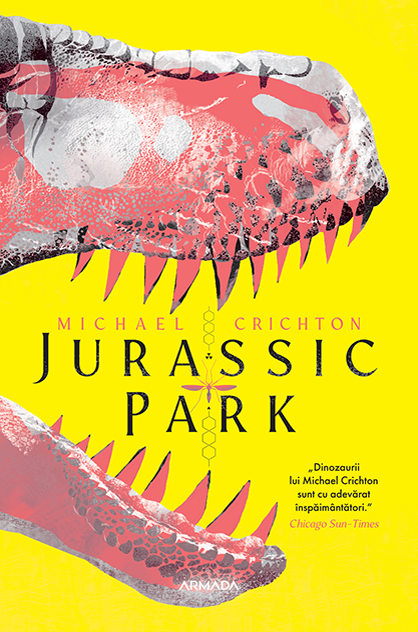
- Rating: ★★★★★
- Editura: Nemira, imprint Armada
- Traducere: Irina Gavrilaș
- Pagini: 480
- Goodreads: Jurassic Park
- Poate fi cumpărată de aici: https://nemira.ro/jurassic-park-michael-crichton
„Jurassic Park” este a treia carte pe care o citesc de la Michael Crichton, după „Germenul Andromeda” și „Evoluția Andromeda”, așa că pot spune că eram deja familiarizată cu stilul autorului și cu felul în care își construiește poveștile. Știam că voi întâlni o narațiune presărată cu informații științifice, explicații tehnice, rapoarte și tot felul de detalii care, deși pot părea uneori complicate, au rolul lor în desfășurarea acțiunii. Tocmai acest amestec dintre ficțiune și știință este unul dintre lucrurile care îmi plac la Crichton, iar „Jurassic Park” mi-a confirmat încă o dată că este un autor la care vreau să mă întorc.
Mi-a plăcut foarte mult cartea, iar unul dintre motivele pentru care lectura a fost atât de plăcută a fost faptul că văzusem filmul cu mult timp în urmă. Mi se pare o ecranizare destul de fidelă în ceea ce privește ideea de bază și evenimentele importante, însă mă bucur că am uitat o mare parte dintre detalii. Am avut senzația că redescopăr povestea, că mă apropii din nou de personaje și că descopăr treptat toate pericolele care îi așteaptă. Chiar dacă știam, în mare, în ce direcție se îndreaptă lucrurile, lectura mi-a oferit suficient de multe momente interesante încât să mă bucur de fiecare etapă a aventurii.
Povestea ne duce pe o insulă îndepărtată, unde John Hammond, un om de afaceri ambițios și foarte bogat, a reușit să transforme o idee aparent imposibilă într-un proiect spectaculos: un parc populat cu dinozauri readuși la viață prin intermediul ingineriei genetice. Pornind de la ADN recuperat din țânțari preistorici conservați în chihlimbar, oamenii de știință reușesc să reconstruiască materialul genetic al unor specii dispărute de milioane de ani. Lacunele din ADN sunt completate prin diferite metode, iar rezultatul este o lume în care dinozaurii nu mai aparțin doar cărților de istorie naturală și muzeelor, ci devin creaturi vii, care se hrănesc, se mișcă și reacționează după propriile instincte. Ideea în sine mi se pare fascinantă și tocmai partea aceasta științifică m-a atras foarte mult. Mi-a plăcut să descopăr cum și-au imaginat oamenii de știință acest proces și cum au încercat să transforme o descoperire incredibilă într-o afacere profitabilă.
Pentru a verifica dacă parcul este pregătit să primească vizitatori, Hammond invită mai mulți specialiști să vadă cu ochii lor ceea ce a construit. Printre ei se numără Alan Grant, paleontologul pasionat de dinozauri, și Ellie Sattler, paleobotanista care îl însoțește și care privește cu interes, dar și cu un ochi critic, ceea ce se întâmplă pe insulă. Lor li se alătură Ian Malcolm, matematicianul specializat în teoria haosului, un personaj care mi-a atras atenția tocmai prin felul în care privește lucrurile și prin încercările sale de a-i face pe ceilalți să înțeleagă că un sistem atât de complex nu poate fi controlat pur și simplu prin câteva calcule și reguli. Malcolm este, într-un fel, vocea care încearcă să avertizeze asupra pericolelor, chiar și atunci când ceilalți preferă să creadă că totul este sub control. Mai apar și nepoții lui Hammond, Tim și Lex, care ajung prinși în mijlocul unor evenimente mult prea periculoase pentru vârsta lor, iar prezența lor face ca anumite momente să fie și mai tensionate.
Un alt personaj important este Dennis Nedry, programatorul responsabil de o parte esențială a sistemelor informatice ale parcului. Nemulțumirile sale și dorința de câștig personal contribuie la declanșarea dezastrului, iar ceea ce mi se pare interesant este că problemele parcului nu pornesc doar de la comportamentul imprevizibil al dinozaurilor, ci și de la greșelile oamenilor. De aici începe, de fapt, adevărata nebunie. Sistemele de securitate cedează, gardurile electrice nu mai reprezintă o protecție sigură, iar creaturile care până atunci puteau fi admirate din spatele unor bariere ajung să se miște libere. Vizita se transformă într-o luptă pentru supraviețuire, iar personajele trebuie să găsească soluții într-un loc în care fiecare decizie greșită poate avea consecințe grave.
Mi-a plăcut mult și felul în care Crichton construiește suspansul. Chiar dacă acțiunea mi s-a părut pe alocuri previzibilă, asta ține mai degrabă de felul meu de a fi. Sunt genul de cititor care, atunci când vede că lucrurile par prea frumoase ca să fie adevărate, începe imediat să se gândească la toate variantele în care ceva ar putea merge îngrozitor de rău. Iar în cazul unui parc plin cu animale preistorice readuse la viață, în care oamenii au impresia că dețin controlul absolut, era aproape imposibil să nu citesc cu un presentiment neplăcut. Am avut senzația constantă că dezastrul pândește după colț și că este doar o chestiune de timp până când totul o va lua la vale. Și, chiar dacă bănuiam încotro se îndreaptă povestea, asta nu mi-a diminuat deloc plăcerea lecturii. Dimpotrivă, am continuat să citesc cu interes, tocmai pentru a vedea cum se vor desfășura lucrurile și cât de departe vor ajunge consecințele tuturor acestor decizii.
Cred că unul dintre cele mai greu de înțeles lucruri pentru mine a fost curajul, sau poate mai degrabă lipsa de prudență, cu care oamenii au decis să readucă la viață niște vietăți despre care, în realitate, știau atât de puține. Faptul că paleontologii au studiat fosile, au făcut săpături și au încercat să înțeleagă aceste specii nu înseamnă că puteau anticipa toate comportamentele unor animale vii, crescute într-un mediu artificial. Una este să studiezi rămășițele unei creaturi dispărute și cu totul alta este să o aduci la viață și să crezi că îi poți controla fiecare mișcare. M-am întrebat de multe ori de ce nu au fost luate mai multe măsuri de siguranță, de ce s-au ignorat anumite riscuri și cum a fost posibil ca un proiect atât de complex să depindă atât de mult de niște sisteme care se puteau defecta. Tocmai aici mi se pare că povestea devine mai mult decât un thriller despre dinozauri.
Pentru mine, „Jurassic Park” vorbește și despre bani, orgoliu, dorința de recunoaștere și tentația omului de a se juca de-a Dumnezeu. John Hammond își dorește să creeze ceva extraordinar, ceva ce nimeni nu a mai făcut vreodată, iar ideea de a rămâne în istorie printr-o asemenea realizare pare să cântărească enorm. În același timp, proiectul este și o afacere, iar promisiunea unor câștiguri uriașe pare să împingă în plan secund întrebările incomode. Cât de departe suntem dispuși să mergem pentru a demonstra că putem face imposibilul? Cât de mult contează etica atunci când succesul, banii și faima sunt la mijloc? Și cine își asumă responsabilitatea atunci când lucrurile nu mai pot fi controlate? Mi se pare că romanul ridică aceste întrebări fără să ofere răspunsuri simple, iar acesta este unul dintre motivele pentru care povestea mi s-a părut atât de interesantă.
Citind cartea, nu am putut să nu fac și o paralelă cu lumea în care trăim astăzi. Poate că nu avem dinozauri care se plimbă liberi pe lângă noi, dar depindem din ce în ce mai mult de tehnologie, de sisteme informatice și de lucruri pe care, de cele mai multe ori, le considerăm garantate. Am mașină electrică, am banii pe card, am tot felul de dispozitive și servicii care îmi fac viața mai ușoară, dar ce se întâmplă dacă, într-o zi, rămânem fără curent? Cât de pregătiți suntem să ne descurcăm atunci când toate aceste sisteme pe care ne bazăm nu mai funcționează? Mi se pare interesant că o carte scrisă cu zeci de ani în urmă poate să te facă să te gândești atât de mult la prezent. În fond, nu este vorba doar despre dinozauri, ci și despre încrederea uneori exagerată pe care o avem în capacitatea noastră de a controla totul.
Și mai este o întrebare pe care mi-am pus-o pe parcursul lecturii: unde ne vom opri cu toate aceste descoperiri? Tehnologia și știința ar trebui să ne ajute, să ne îmbunătățească viața și să ne ofere soluții la probleme reale, dar uneori am impresia că suntem atât de preocupați de ceea ce putem face, încât uităm să ne întrebăm dacă și trebuie să facem acel lucru. Jurassic Park mi-a amintit că progresul nu înseamnă doar descoperiri spectaculoase, ci și responsabilitate, limite și capacitatea de a accepta că nu toate lucrurile pot fi prevăzute. Iar atunci când ambiția ajunge să fie mai importantă decât siguranța, consecințele pot deveni imposibil de reparat.
Per total, mi-a plăcut enorm „Jurassic Park”. Este genul de carte care reușește să combine foarte bine acțiunea, suspansul, personajele și informațiile științifice, fără să piardă din vedere povestea. Mi-au plăcut ideea, atmosfera, felul în care tensiunea crește treptat și, mai ales, faptul că am avut mereu ceva la care să mă gândesc dincolo de evenimentele propriu-zise. Poate că unele momente mi s-au părut previzibile, dar asta nu a schimbat cu nimic experiența mea de lectură. Din contră, am apreciat că, deși știam în mare ce mă așteaptă, am reușit să mă bucur de poveste ca și cum aș fi descoperit-o pentru prima dată.
Îi acord cinci stele pentru că mi-a oferit exact genul de lectură pe care îl caut: o poveste captivantă, o idee fascinantă și suficiente întrebări cât să mă urmărească și după ce am terminat-o. Sunt foarte curioasă să citesc și continuarea, „The Lost World”, și să văd în ce direcție va duce Michael Crichton această poveste. Dacă va reuși să mă surprindă la fel de mult și să-mi ofere noi motive de reflecție, cu siguranță voi fi mai mult decât încântată să mă întorc în această lume.

Jurassic Park – Michael Crichton (Jurassic Park, #1)
“Jurassic Park” is the third book I’ve read by Michael Crichton, after “The Andromeda Strain” and “The Andromeda Evolution”, so I can say I was already familiar with the author’s style and the way he builds his stories. I knew I would find a narrative filled with scientific information, technical explanations, reports, and all sorts of details that, while sometimes a little complicated, serve a purpose in moving the plot forward. This blend of fiction and science is one of the things I like about Crichton, and “Jurassic Park” confirmed once again that he is an author I want to keep coming back to.
I really enjoyed this book, and one of the reasons I found it such a pleasant read was that I had watched the movie a long time ago. I think the adaptation stays fairly faithful to the basic premise and the major events, but I’m glad I had forgotten quite a lot of the details. It felt like rediscovering the story, getting reacquainted with the characters, and gradually uncovering all the dangers waiting for them. Even though I had a general idea of where things were heading, the book offered enough interesting moments to keep me engaged and make me enjoy every stage of the adventure.
The story takes us to a remote island where John Hammond, an ambitious and extremely wealthy businessman, has managed to turn what seems like an impossible idea into a spectacular project: a park populated by dinosaurs brought back to life through genetic engineering. Using DNA recovered from prehistoric mosquitoes preserved in amber, scientists manage to reconstruct the genetic material of species that went extinct millions of years ago. The gaps in the DNA are filled using various methods, and the result is a world where dinosaurs are no longer confined to natural history books and museums but become living creatures that feed, move, and react according to their own instincts. I find the idea itself fascinating, and the scientific aspect was one of the things that drew me in the most. I enjoyed discovering how the scientists envisioned this process and how they attempted to turn an incredible scientific achievement into a profitable business.
To determine whether the park is ready to welcome visitors, Hammond invites several specialists to see what he has built with their own eyes. Among them are Alan Grant, a paleontologist passionate about dinosaurs, and Ellie Sattler, the paleobotanist accompanying him, who observes what is happening on the island with both curiosity and a critical eye. They are joined by Ian Malcolm, a mathematician specializing in chaos theory, a character who caught my attention because of the way he looks at things and tries to make others understand that a system this complex cannot simply be controlled with a few calculations and rules. In a way, Malcolm is the voice trying to warn everyone about the dangers, even when the others would rather believe everything is under control. Hammond’s grandchildren, Tim and Lex, are also there, and they find themselves caught up in events far too dangerous for their age. Their presence makes certain moments even more tense.
Another important character is Dennis Nedry, the programmer responsible for a crucial part of the park’s computer systems. His frustrations and desire for personal gain help set the disaster in motion, and what I find interesting is that the park’s problems are not caused solely by the unpredictable behavior of the dinosaurs, but also by human mistakes. This is where things really start to spiral out of control. The security systems fail, the electric fences are no longer a reliable means of protection, and the creatures that could previously be admired from behind barriers are suddenly roaming free. The visit turns into a fight for survival, and the characters must find solutions in a place where every wrong decision can have serious consequences.
I also really liked the way Crichton builds suspense. Even though I found the plot somewhat predictable at times, that has more to do with the way I am as a reader. I’m the kind of person who, whenever things seem too good to be true, immediately starts thinking about all the ways they could go terribly wrong. And when it comes to a park full of prehistoric animals brought back to life, where people believe they have absolute control, it was almost impossible not to read with a sense of unease. I constantly felt that disaster was just around the corner and that it was only a matter of time before everything fell apart. And even though I had a pretty good idea of where the story was heading, that didn’t take away from my enjoyment at all. If anything, it made me want to keep reading, eager to see how things would unfold and just how far-reaching the consequences of all these decisions would be.
I think one of the hardest things for me to understand was the courage, or perhaps the sheer recklessness, with which people decided to bring creatures back to life when, in reality, they knew so little about them. The fact that paleontologists had studied fossils, carried out excavations, and tried to understand these species didn’t mean they could predict every aspect of the behavior of living animals raised in an artificial environment. Studying the remains of an extinct creature is one thing; bringing it back to life and believing you can control its every move is something else entirely. I found myself wondering why more safety measures hadn’t been put in place, why certain risks had been ignored, and how a project this complex could depend so heavily on systems that could fail. This is where I think the story becomes more than just a dinosaur thriller.
To me, “Jurassic Park” is also about money, ego, the desire for recognition, and the temptation to play God. John Hammond wants to create something extraordinary, something no one has ever done before, and the idea of going down in history for such an achievement seems to mean a great deal to him. At the same time, the project is also a business, and the promise of enormous profits seems to push uncomfortable questions into the background. How far are we willing to go to prove that we can do the impossible? How much does ethics really matter when success, money, and fame are at stake? And who takes responsibility when things can no longer be controlled? I think the novel raises these questions without offering simple answers, and that’s one of the reasons I found the story so compelling.
While reading the book, I couldn’t help drawing a parallel with the world we live in today. We may not have dinosaurs roaming freely around us, but we depend more and more on technology, computer systems, and things we often take for granted. I have an electric car, my money is on my card, and I use all sorts of devices and services that make my life easier, but what happens if one day we lose power? How prepared are we to manage when all these systems we rely on stop working? I find it interesting that a book written decades ago can make you think so much about the present. After all, it’s not just about dinosaurs, but also about the sometimes excessive confidence we place in our ability to control everything.
There’s another question I kept asking myself as I read: where will we draw the line with all these discoveries? Technology and science should help us, improve our lives, and offer solutions to real problems, but sometimes I feel we’re so focused on what we can do that we forget to ask ourselves whether we should do it at all. “Jurassic Park” reminded me that progress isn’t just about spectacular discoveries, but also about responsibility, boundaries, and the ability to accept that not everything can be predicted. And when ambition becomes more important than safety, the consequences can become impossible to undo.
Overall, I absolutely loved “Jurassic Park”. It’s the kind of book that manages to combine action, suspense, characters, and scientific information really well without losing sight of the story itself. I loved the premise, the atmosphere, the way the tension gradually builds, and, most importantly, the fact that I always had something to think about beyond the events themselves. Some moments may have felt predictable to me, but that didn’t change my reading experience in the slightest. On the contrary, I appreciated the fact that even though I already knew roughly what to expect, I was still able to enjoy the story as if I were discovering it for the first time.
I’m giving it five stars because it gave me exactly the kind of reading experience I’m looking for: a captivating story, a fascinating idea, and enough questions to stay with me even after I finished the book. I’m really curious to read the sequel, “The Lost World”, and see where Michael Crichton takes this story next. If he manages to surprise me just as much and give me even more to think about, I’ll definitely be more than happy to return to this world.
