
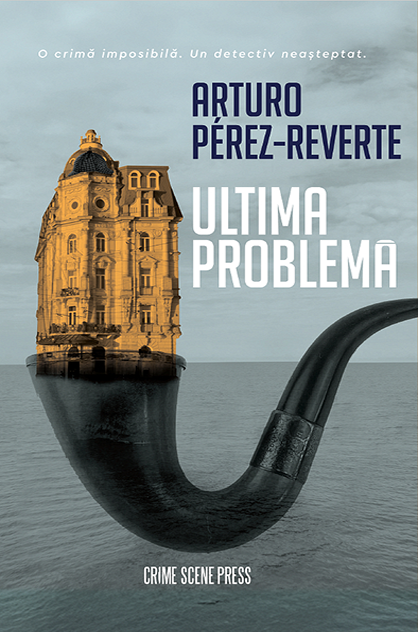
- Rating: ★★★☆☆
- Editura: Crime Scene Press
- Traducere: Laura Drăghici
- Pagini: 312
- Goodreads: Ultima problemă
- Poate fi cumpărată de aici: https://crimescenepress.ro/product/ultima-problema
„Ultima problemă” de Arturo Pérez-Reverte este genul de roman care te duce cu gândul la misterele clasice, acele povești în care fiecare detaliu contează și fiecare personaj ascunde ceva. Pentru mine, a fost o lectură interesantă, dar nu neapărat una care să mă țină complet captivă de la început până la final, motiv pentru care îi acord trei stele.
Acțiunea are loc în iunie 1960, pe o insulă aparent liniștită de lângă Corfu, unde o furtună puternică izolează complet un mic grup de oameni într-un hotel cochet. Atmosfera devine rapid apăsătoare, iar sentimentul că nimeni nu poate pleca și nimeni nu poate veni creează acel tip de tensiune specific romanelor polițiste clasice. Totul se schimbă în momentul în care Edith Mander, o turistă engleză retrasă, este găsită moartă într-un pavilion de pe plajă. La prima vedere, pare o sinucidere, dar lucrurile nu sunt chiar atât de simple.
Personajul care mi-a atras cel mai mult atenția este Hopalong Basil, un actor ajuns la sfârșitul carierei, cunoscut pentru rolul unui detectiv celebru. Mi s-a părut interesant cum autorul îl transformă într-un fel de detectiv „din întâmplare”, punându-l să folosească logica și observația pe care le-a jucat ani de zile pe ecran. Este un contrast plăcut între aparență și realitate, iar Basil devine cheia în deslușirea unei crime care pare imposibil de explicat.
Pe parcurs, povestea devine un adevărat joc între autor și cititor. Ai impresia că ești provocat constant să ghicești cine este vinovatul, iar fiecare indiciu pare să te ducă într-o altă direcție. Misterul este construit cu grijă și rămâne ascuns până foarte aproape de final, când toate piesele încep, în sfârșit, să se lege.
Totuși, trebuie să recunosc că ritmul cărții mi s-a părut destul de lent, iar numărul mare de personaje m-a făcut, pe alocuri, să pierd firul narativ sau să simt că povestea stagnează. Chiar și așa, personajele sunt bine conturate, fiecare având propriile motive și secrete, ceea ce te face să continui lectura, din dorința de a descoperi adevărul.
Per total, cred că este o carte care ar putea fi pe placul celor care iubesc stilul clasic al autoarei Agatha Christie sau poveștile cu Sherlock Holmes create de Arthur Conan Doyle. Deși nu a fost complet pe gustul meu, ideea mi s-a părut originală și bine construită, iar atmosfera de mister te face să rămâi până la final, încercând să descoperi cine este criminalul într-o poveste în care nimic nu este ceea ce pare.


The Final Problem – Arturo Pérez-Reverte
“The Final Problem” by Arturo Pérez-Reverte is the kind of novel that brings to mind classic mysteries—those stories where every detail matters and every character hides something. For me, it was an interesting read, but not one that kept me fully captivated from beginning to end, which is why I’m giving it three stars.
The action takes place in June 1960, on a seemingly quiet island near Corfu, where a powerful storm completely isolates a small group of people in a charming hotel. The atmosphere quickly becomes tense, and the feeling that no one can leave and no one can arrive creates that distinctive tension typical of classic detective novels. Everything changes when Edith Mander, a reclusive English tourist, is found dead in a beach pavilion. At first glance, it appears to be suicide, but things are not quite so simple.
The character who caught my attention the most is Hopalong Basil, an actor at the end of his career, known for playing a famous detective. I found it interesting how the author turns him into a sort of “accidental” detective, forcing him to use the logic and observation he portrayed on screen for years. There’s a nice contrast between appearance and reality, and Basil becomes the key to unraveling a crime that seems impossible to explain.
As the story unfolds, it becomes a true game between the author and the reader. You feel constantly challenged to guess who the culprit is, and every clue seems to lead you in a different direction. The mystery is carefully constructed and remains hidden until very close to the end, when all the pieces finally begin to fall into place.
However, I have to admit that the pace of the book felt quite slow to me, and the large number of characters occasionally made me lose track of the narrative or feel that the story was stagnating. Even so, the characters are well developed, each with their own motives and secrets, which keeps you reading out of a desire to discover the truth.
Overall, I think this is a book that would appeal to those who love the classic style of Agatha Christie or the Sherlock Holmes stories created by Arthur Conan Doyle. Although it wasn’t entirely to my taste, I found the idea original and well crafted, and the mysterious atmosphere keeps you engaged until the very end, trying to uncover the killer in a story where nothing is what it seems.
