
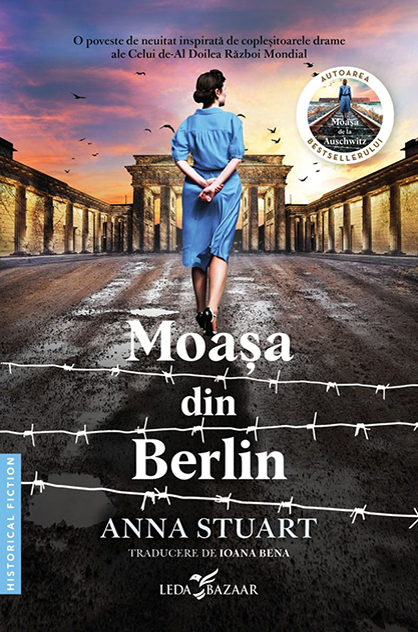
- Rating: ★★★★★
- Editura: Corint, imprint Leda Bazaar
- Traducere: Ioana Bena
- Pagini: 464
- Goodreads: Moașa din Berlin
- Poate fi cumpărată de aici: https://edituracorint.ro/moasa-de-la-auschwitz-2-fiica-pierduta.html
„Moașa din Berlin” de Anna Stuart este una dintre acele cărți care nu doar se citesc, ci se simt până în adâncul sufletului. Pentru mine, a fost o experiență intensă și profund emoționantă, o poveste care m-a prins încă de la primele pagini și m-a captivat pe tot parcursul lecturii. Am fost mereu atrasă de poveștile despre Auschwitz și despre Al Doilea Război Mondial, dar această carte a reușit să mă atingă într-un mod aparte, să mă facă să trăiesc fiecare moment alături de personaje, până la lacrimi.
Povestea o urmărește pe Ester Pasternak, o femeie puternică, dar profund rănită, care reușește să supraviețuiască infernului de la Auschwitz. În 1943, în mijlocul ororilor, ea aduce pe lume o fetiță, un miracol fragil într-un loc al morții. Faptul că micuța are părul blond devine singura ei șansă la viață, dar și începutul unei suferințe cumplite, pentru că este smulsă din brațele mamei și dată unei familii germane. Momentul despărțirii este sfâșietor și rămâne ca o rană deschisă pe tot parcursul cărții.
În 1945, Ester iese din lagăr slăbită, dar vie, iar dorința de a-și regăsi copilul devine singurul motiv pentru care merge mai departe. Berlinul de după război este un loc haotic, plin de ruine și de oameni pierduți, fiecare încercând să își regăsească familia. Ester cutreieră spitale și orfelinate, căutând printre zeci de copii chipul fiicei sale. Fiecare copil blond pe care îl vede îi aprinde o speranță, dar și o teamă imensă. Este o căutare dureroasă, plină de incertitudine, care te ține cu sufletul la gură.
Ce mi-a plăcut enorm la această carte este modul în care autoarea reușește să redea emoțiile personajelor. Nu doar Ester este construită cu grijă, ci și personajele secundare, fiecare cu propria poveste, propriile traume și speranțe. Am simțit lupta lor pentru supraviețuire, revolta în fața nedreptății și dorința disperată de a găsi un sens într-o lume distrusă. Este genul de carte în care ajungi să empatizezi foarte ușor cu fiecare personaj, să le înțelegi alegerile și suferința.
Deși este o poveste încărcată de durere și pierdere, nu este lipsită de lumină. Din contră, printre toate momentele grele, am simțit o speranță puternică, mai ales în clipele în care personajele reușesc să se regăsească după ani de separare. Aceste momente sunt cu adevărat emoționante și îți oferă acel sentiment că, indiferent cât de întunecate sunt vremurile, există întotdeauna o șansă la regăsire și la vindecare.
Stilul de scriere este cursiv și foarte accesibil, ceea ce face lectura ușoară, dar în același timp profundă. Autoarea are un talent aparte de a te face să vezi scenele, să simți atmosfera și să trăiești alături de personaje. Am citit cu sufletul strâns, dorindu-mi mereu să aflu ce se va întâmpla mai departe, cum va evolua povestea și dacă Ester va reuși să își găsească fiica.
Este, fără îndoială, o poveste despre curaj, despre încăpățânarea de a nu renunța și despre puterea unei mame de a spera, chiar și atunci când totul pare pierdut. O carte care te marchează și care rămâne cu tine mult timp după ce ai terminat-o. Pentru mine, a fost o lectură de cinci stele, pe care o recomand din toată inima celor care iubesc poveștile emoționante, pline de istorie și umanitate.


The Midwife of Berlin – Anna Stuart (Women of War, #2)
“The Midwife of Berlin” by Anna Stuart is one of those books that isn’t just read—it’s felt deep in your soul. For me, it was an intense and profoundly emotional experience, a story that hooked me from the very first pages and kept me captivated throughout. I’ve always been drawn to stories about Auschwitz and World War II, but this book touched me in a unique way, making me live every moment alongside the characters, to the point of tears.
The story follows Ester Pasternak, a strong yet deeply wounded woman who manages to survive the hell of Auschwitz. In 1943, in the midst of unimaginable horrors, she gives birth to a baby girl—a fragile miracle in a place of death. The fact that the little girl has blonde hair becomes her only chance at survival, but also the beginning of unbearable suffering, as she is torn from her mother’s arms and given to a German family. That moment of separation is heartbreaking and remains an open wound throughout the entire book.
In 1945, Ester leaves the camp weak but alive, and her desire to find her child becomes the only reason she keeps going. Post-war Berlin is chaotic, filled with ruins and lost people, each trying to find their families. Ester searches through hospitals and orphanages, looking among dozens of children for her daughter’s face. Every blonde child she sees sparks both hope and immense fear. It’s a painful, uncertain journey that keeps you on edge.
What I absolutely loved about this book is how the author conveys the characters’ emotions. Not only is Ester carefully developed, but the secondary characters are as well, each with their own story, traumas, and hopes. I could feel their struggle to survive, their anger at injustice, and their desperate need to find meaning in a shattered world. It’s the kind of book where you easily empathize with every character, understanding their choices and their pain.
Although the story is filled with sorrow and loss, it is not without light. On the contrary, amid all the hardship, there is a strong sense of hope—especially in the moments when characters manage to reunite after years of separation. These scenes are truly moving and give you the feeling that, no matter how dark the times, there is always a chance for reunion and healing.
The writing style is fluid and very accessible, making the book easy to read yet deeply impactful. The author has a special talent for making you see the scenes, feel the atmosphere, and live alongside the characters. I read it with a tight chest, constantly wanting to know what would happen next, how the story would unfold, and whether Ester would find her daughter.
It is, without a doubt, a story about courage, about the stubborn refusal to give up, and about a mother’s power to hope—even when everything seems lost. A book that leaves a mark and stays with you long after you’ve finished it. For me, it was a five-star read that I wholeheartedly recommend to anyone who loves emotional stories filled with history and humanity.
