
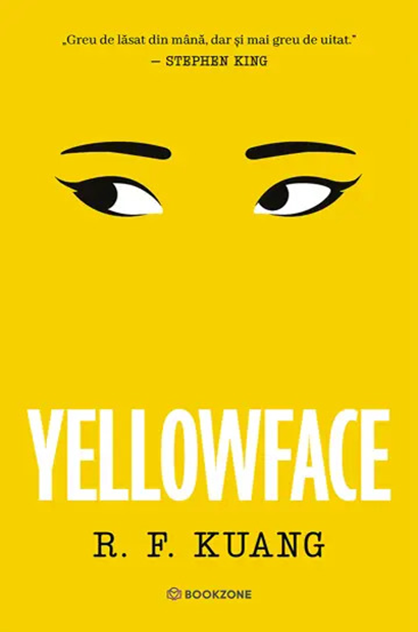
- Rating: ★★★★★
- Editura: Bookzone
- Traducere: Mihai-Dan Pavelescu
- Pagini: 368
- Goodreads: Yellowface
- Poate fi cumpărată de aici: https://bookzone.ro/carte/yellowface-bkz
Dacă până acum o asociam pe R.F. Kuang aproape exclusiv cu romanele fantasy care m-au cucerit complet, „Yellowface” mi-a demonstrat încă o dată că talentul ei nu ține de un singur gen literar. Nu mai este niciun secret că este una dintre autoarele mele preferate, iar cărțile ei au ajuns de mult pe lista celor pe care le recomand cu toată încrederea. De această dată, însă, a lăsat în urmă magia și lumile fantastice pentru a scrie un roman contemporan, o satiră extrem de inteligentă, iar rezultatul m-a impresionat poate chiar mai mult decât mă așteptam.
Consider că R.F. Kuang este o adevărată maestră a cuvintelor. Are un mod aparte de a construi povești, de a ascunde sensuri printre rânduri și de a te face să privești din mai multe perspective aceeași situație. În „Yellowface”, reușește să creeze o poveste atât de realistă și de bine documentată, încât, pe măsură ce înaintezi cu lectura, ajungi să te întrebi de multe ori dacă citești un roman de ficțiune sau dacă ai în față o poveste inspirată din realitate. Tot ceea ce se întâmplă pare atât de posibil și atât de actual, încât granița dintre ficțiune și realitate devine aproape invizibilă.
Romanul, bestseller New York Times, devenit un adevărat fenomen literar cu peste 1,5 milioane de exemplare vândute, a fost desemnat Cea mai bună carte de ficțiune la Goodreads Choice Awards 2023, Cartea anului 2023 de Amazon UK și Cartea de ficțiune a anului la British Book Awards 2024. Nu este deloc greu de înțeles de ce a primit atât de multe aprecieri. Așa cum spunea și Stephen King, este o carte „greu de lăsat din mână, dar și mai greu de uitat”, iar după ce am terminat-o, am continuat să mă gândesc mult timp la temele pe care le abordează și la întrebările pe care le ridică.
Povestea începe cu Athena Liu, o scriitoare chinezo-americană extrem de apreciată, autoare de bestsellere și una dintre cele mai cunoscute voci din lumea literară. În contrast cu ea se află June Hayward, o scriitoare care nu a reușit să cunoască succesul și care trăiește permanent cu sentimentul că talentul ei nu este remarcat. Cele două se cunosc, însă viețile lor iau o întorsătură complet neașteptată atunci când Athena moare într-un accident absurd, chiar sub privirile lui June.
În fața unui manuscris neterminat, June ia o decizie care îi va schimba întreaga viață. Fură romanul Athenei, îl rescrie foarte puțin și îl publică sub propriul nume, convinsă că meritul îi aparține pentru că a avut curajul să îl aducă în fața publicului. Succesul apare aproape peste noapte, dar odată cu el încep și minciunile, compromisurile și frica permanentă că adevărul va ieși la iveală. Pentru a-și susține povestea, June își construiește inclusiv o identitate ambiguă, încercând să profite de percepția publicului și de imaginea creată în jurul ei. Pe măsură ce devine tot mai cunoscută, scandalurile din mediul online, acuzațiile și presiunea publică încep să îi amenințe cariera și întreaga existență.
Unul dintre lucrurile care mi-au plăcut cel mai mult a fost construcția personajului principal. June nu este un personaj pe care îl poți încadra ușor în categoria celor buni sau răi. Este complexă, contradictorie și extrem de bine construită. Am avut momente în care am înțeles-o și i-am simțit frustrările, nesiguranțele și dorința disperată de a fi apreciată. În alte momente, însă, am fost revoltată de alegerile pe care le face și de felul în care încearcă să își justifice fiecare minciună. Tocmai această ambiguitate morală face ca personajul să fie atât de credibil. R.F. Kuang reușește să te facă să trăiești alături de June toate etapele transformării ei și să treci printr-un adevărat carusel emoțional: empatie, compasiune, frustrare, furie și chiar milă.
Mi-a plăcut enorm și felul în care este prezentată Athena, chiar dacă prezența ei în poveste este diferită de cea a lui June. Prin amintiri, conversații și felul în care ceilalți o descriu, Athena rămâne o prezență puternică pe tot parcursul romanului. Relația dintre cele două este mult mai complicată decât pare la început și scoate la suprafață teme precum invidia, competiția, nevoia de validare și dorința de recunoaștere.
Subiectul abordat mi s-a părut extraordinar de interesant și foarte bine dezvoltat. Cartea vorbește despre lumea editorială, despre succes, despre privilegiu, despre identitate, despre rasă, despre cine are dreptul să spună o anumită poveste și despre cât de ușor poate fi influențată opinia publică în era rețelelor sociale. Toate aceste teme sunt analizate cu foarte multă atenție și din perspective diferite, fără ca povestea să își piardă ritmul sau să devină obositoare. Dimpotrivă, fiecare capitol adaugă un nou detaliu și o nouă întrebare, iar tensiunea crește constant până la final.
Mi-a plăcut foarte mult faptul că romanul nu oferă răspunsuri simple și nici personaje perfecte. Te provoacă să îți pui întrebări despre moralitate, despre succes și despre limitele pe care oamenii sunt dispuși să le depășească pentru a obține recunoaștere. Este una dintre acele cărți care nasc discuții și care îți rămân în minte mult timp după ce ai întors ultima pagină.
Pentru mine, „Yellowface” este încă o dovadă că R.F. Kuang poate scrie excepțional indiferent de genul literar pe care îl abordează. M-a captivat de la primele pagini, m-a făcut să analizez fiecare situație și fiecare personaj și mi-a oferit una dintre cele mai memorabile experiențe de lectură din ultimii ani. Este un roman inteligent, provocator, actual și incredibil de captivant, pe care îl recomand din toată inima tuturor celor care își doresc o poveste diferită, care nu doar distrează, ci și pune sub semnul întrebării multe dintre realitățile lumii în care trăim.


Yellowface – R.F. Kuang
Until now, I had associated R.F. Kuang almost exclusively with the fantasy novels that completely captivated me, but „Yellowface” proved once again that her talent is by no means limited to a single literary genre. It is no secret that she is one of my favorite authors, and her books have long been among the ones I recommend with complete confidence. This time, however, she left magic and fantastical worlds behind to write a contemporary novel—an exceptionally clever satire—and the result impressed me even more than I had expected.
I truly believe that R.F. Kuang is a master of words. She has a unique way of crafting stories, hiding meaning between the lines, and encouraging readers to view the same situation from multiple perspectives. In „Yellowface”, she creates a story so realistic and meticulously researched that, as you read, you often find yourself wondering whether you’re reading a work of fiction or a story inspired by real events. Everything that happens feels so plausible and so relevant that the line between fiction and reality becomes almost invisible.
A New York Times bestseller that has become a true literary phenomenon with more than 1.5 million copies sold, the novel was named Best Fiction Book at the Goodreads Choice Awards 2023, Amazon UK’s Book of the Year 2023, and Fiction Book of the Year at the British Book Awards 2024. It’s not difficult to understand why it has received such widespread acclaim. As Stephen King put it, it is “hard to put down, even harder to forget,” and after finishing it, I found myself thinking about its themes and the questions it raises for a long time afterward.
The story begins with Athena Liu, a highly acclaimed Chinese American author, bestselling novelist, and one of the most prominent voices in the literary world. In contrast, there is June Hayward, a struggling writer who has never achieved success and constantly feels that her talent goes unnoticed. Although the two know each other, their lives take a completely unexpected turn when Athena dies in a bizarre accident right in front of June.
Faced with Athena’s unfinished manuscript, June makes a decision that will change her life forever. She steals the novel, makes only minor revisions, and publishes it under her own name, convincing herself that she deserves the credit simply because she had the courage to bring it to the public. Success comes almost overnight, but with it come lies, compromises, and the constant fear that the truth will eventually come to light. To support her deception, June even cultivates an ambiguous identity, attempting to take advantage of the public’s perception and the image built around her. As she becomes increasingly famous, online controversies, accusations, and mounting public scrutiny begin to threaten not only her career but her entire existence.
One of the things I loved most about the novel was the construction of its main character. June is not someone you can easily categorize as either good or bad. She is complex, contradictory, and incredibly well developed. There were moments when I understood her and genuinely sympathized with her frustrations, insecurities, and desperate desire to be recognized. At other times, however, I was outraged by the choices she made and by the way she tried to justify every lie she told. It is precisely this moral ambiguity that makes her feel so believable. R.F. Kuang allows readers to experience every stage of June’s transformation, taking them on a true emotional roller coaster filled with empathy, compassion, frustration, anger, and even pity.
I also loved the way Athena is portrayed, even though her presence in the story differs from June’s. Through memories, conversations, and the way other characters describe her, Athena remains a powerful presence throughout the novel. The relationship between the two women is far more complicated than it initially appears, bringing themes such as envy, competition, the need for validation, and the desire for recognition to the surface.
I found the central premise incredibly compelling and exceptionally well developed. The novel explores the publishing industry, success, privilege, identity, race, who has the right to tell certain stories, and how easily public opinion can be manipulated in the age of social media. All of these themes are examined with remarkable depth and from multiple perspectives without ever slowing the pace or making the story feel overwhelming. On the contrary, each chapter introduces another layer and another question, while the tension steadily builds until the very end.
I especially appreciated the fact that the novel offers neither simple answers nor perfect characters. Instead, it challenges readers to question morality, success, and the limits people are willing to cross in pursuit of recognition. It is one of those books that naturally sparks discussion and lingers in your mind long after you’ve turned the final page.
For me, „Yellowface” is yet another testament to the fact that R.F. Kuang is capable of writing brilliantly regardless of the genre she chooses. The novel captivated me from the very first pages, encouraged me to analyze every situation and every character, and gave me one of the most memorable reading experiences I’ve had in recent years. It is an intelligent, thought-provoking, timely, and utterly compelling novel that I wholeheartedly recommend to anyone looking for a story that does more than entertain—it challenges many of the assumptions and realities of the world we live in.
