
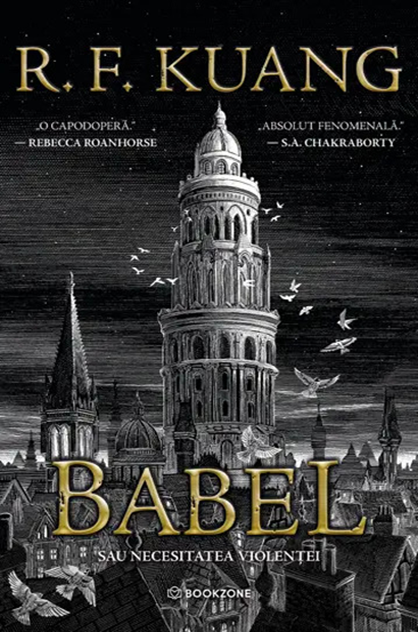
- Rating: ★★★★★
- Editura: Bookzone
- Traducere: Mihai-Dan Pavelescu
- Pagini: 720
- Goodreads: Babel
- Poate fi cumpărată de aici: https://bookzone.ro/carte/babel-bkz
În „Babel” de R. F. Kuang, cuvintele nu sunt doar instrumente de comunicare. Ele pot apropia oamenii, dar pot fi și folosite pentru a-i controla. Într-o lume în care traducerea ascunde atât o formă de magie, cât și o formă de putere, fiecare alegere are un preț. Povestea m-a făcut să mă gândesc la cât de greu este să înțelegi cu adevărat pe cineva atunci când vorbiți limbi diferite și când fiecare vine cu propriile răni și convingeri.
Acțiunea începe în 1828, când Robin Swift, un băiat rămas orfan în urma holerei din Canton, este dus la Londra de profesorul Lovell. Robin învață ani întregi limbi precum latina, greaca veche și chineza, până când ajunge la Babel, Institutul Regal de Traduceri din Oxford. Acolo descoperă argintoria: o magie care folosește diferențele dintre limbi pentru a da argintului puteri neobișnuite. Babel este un loc al cunoașterii și al marilor descoperiri, dar și unul dintre pilonii puterii Imperiului Britanic.
Robin este un personaj care m-a impresionat prin felul în care se schimbă pe măsură ce înțelege lumea din jurul său. Își dorește să învețe, să aparțină acelui loc și să fie apreciat pentru talentul lui. În același timp, nu poate ignora faptul că succesul Babelului se sprijină pe exploatarea altor țări, inclusiv a patriei sale. În jurul lui se află colegii săi, Letty, Ramy și Victoire, fiecare cu propria poveste și cu propriile motive de a rămâne sau de a se împotrivi. Împreună formează un grup apropiat, dar nu sunt mereu de acord, iar tocmai aceste diferențe fac relațiile dintre ei credibile și interesante.
Pe măsură ce studiile lor avansează, Robin și prietenii lui ajung să vadă tot mai limpede ce se ascunde în spatele prestigiului Babelului. Societatea secretă Hermes le oferă o cale de a lupta împotriva expansiunii imperiale, dar implicarea în această luptă cere sacrificii. Când Marea Britanie se pregătește să pornească un război nedrept împotriva Chinei, personajele trebuie să hotărască ce sunt dispuse să piardă. Mi-a plăcut că romanul nu le oferă răspunsuri ușoare: uneori, cunoașterea și loialitatea se ciocnesc, iar alegerea care pare corectă poate să rănească pe cineva sau să aibă urmări neașteptate. Ca în viața reală, nu există întotdeauna un singur drum bun și nici certitudinea că ai ales cel mai potrivit.
Mi-a plăcut foarte mult felul în care sunt construite personajele. Sunt complexe, au slăbiciuni și contradicții, iar în ele se simte mereu lupta dintre dorința de a învăța și nevoia de a-și apăra principiile. Le-am înțeles atașamentul față de lumea academică și atracția pe care o exercită Babelul, dar am simțit și neliniștea lor când au început să vadă prețul acestei lumi. Tocmai această dualitate m-a făcut să mă atașez de ei și să mă întreb ce aș fi făcut în locul lor.
Oxfordul din roman mi s-a părut aproape un personaj în sine. Kuang îl conturează cu frumusețea, energia și farmecul său, dar nu ascunde nici nedreptățile și neajunsurile orașului. M-a fascinat cât de mult depinde viața de acolo de argintorie și câte întrebuințări are magia în lucrurile de zi cu zi, în progres și în puterea Imperiului. Orașul pare să înflorească datorită cunoașterii, însă cititorul ajunge treptat să vadă cine plătește pentru această prosperitate.
Nu încetez să mă minunez de complexitatea lumii pe care o creează R. F. Kuang și de atenția cu care își imaginează regulile, limbile și legăturile dintre ele. Se simte câtă muncă stă în spatele acestei povești ample, dar ideile mari nu îndepărtează cititorul de personaje. Dimpotrivă, povestea lor personală face ca temele despre limbaj, putere și apartenență să capete greutate. Am apreciat și trimiterile discrete către celelalte cărți ale autoarei, mai ales către seria „Războiul macului”, pe care am îndrăgit-o mult. Pentru mine, aceste mici legături au fost o bucurie în plus.
Acțiunea m-a ținut captivă pe tot parcursul lecturii. Am vrut să ajung cât mai repede la final, să aflu ce alegere vor face personajele și ce se va întâmpla cu ei, deși în același timp nu voiam să părăsesc lumea cărții. „Babel” m-a făcut să râd, să mă neliniștesc și să mă gândesc mult la ce înseamnă să-ți folosești cunoașterea pentru binele cui. Este una dintre acele povești care continuă să-ți rămână în minte și după ce ai închis cartea.
Mi-a plăcut enorm „Babel” și mă bucur că am ajuns la zi cu toate cărțile lui R. F. Kuang traduse la noi. Am găsit aici o poveste ambițioasă, emoționantă și plină de personaje pe care am vrut să le înțeleg, chiar și atunci când nu le-am aprobat alegerile. Pentru mine, a fost o lectură de cinci stele: captivantă, bogată în idei și construită cu multă grijă.


Babel – R.F. Kuang
In „Babel” by R. F. Kuang, words are more than tools for communication. They can bring people closer, but they can also be used to control them. In a world where translation conceals both a kind of magic and a kind of power, every choice comes at a price. The story made me think about how hard it is to truly understand someone when you speak different languages and each of you carries your own wounds and beliefs.
The story begins in 1828, when Robin Swift, orphaned by the cholera outbreak in Canton, is brought to London by Professor Lovell. Robin spends years learning languages such as Latin, Ancient Greek, and Chinese, until he arrives at Babel, Oxford’s Royal Institute of Translation. There, he discovers silver-working: a form of magic that uses differences between languages to give silver unusual powers. Babel is a place of knowledge and great discoveries, but it is also one of the pillars of the British Empire’s power.
Robin impressed me with the way he changes as he comes to understand the world around him. He wants to learn, to belong there, and to be valued for his talent. At the same time, he cannot ignore the fact that Babel’s success rests on the exploitation of other countries, including his homeland. His friends Letty, Ramy, and Victoire each have their own stories and reasons for staying or resisting. Together, they form a close-knit group, but they do not always agree—and those differences are what make their relationships feel believable and compelling.
As their studies progress, Robin and his friends see more and more clearly what lies behind Babel’s prestige. The secret society Hermes offers them a way to fight imperial expansion, but joining that struggle demands sacrifices. When Britain prepares to wage an unjust war against China, the characters must decide what they are willing to lose. I liked that the novel offers no easy answers: sometimes knowledge and loyalty collide, and what seems like the right choice can hurt someone or have unexpected consequences. As in real life, there is not always one right path, nor any certainty that you have chosen the best one.
I loved the way the characters are developed. They are complex, with flaws and contradictions, and they are constantly caught between the desire to learn and the need to defend their principles. I understood their attachment to academia and the pull Babel exerted on them, but I also felt their unease as they began to see the price of that world. That duality made me grow attached to them and wonder what I would have done in their place.
Oxford in the novel felt almost like a character in its own right. Kuang brings out its beauty, energy, and charm, but she does not hide the city’s injustices and shortcomings. I was fascinated by how much life there depends on silver-working, and by the many ways magic is used in everyday life, in progress, and in the Empire’s power. The city seems to flourish through knowledge, but the reader gradually comes to see who pays for that prosperity.
I never cease to be amazed by the complexity of the world R. F. Kuang creates and by the care with which she imagines its rules, languages, and the connections between them. You can feel how much work went into this sweeping story, but its big ideas never distance the reader from the characters. On the contrary, their personal stories give real weight to its themes of language, power, and belonging. I also appreciated the subtle references to the author’s other books, especially „The Poppy War” series, which I loved. Those small connections were an added pleasure for me.
The story kept me engrossed throughout. I wanted to reach the end as quickly as possible to find out what the characters would choose and what would happen to them, even as I wished I could stay in the world of the book. „Babel” made me laugh, feel uneasy, and think deeply about what it means to use knowledge—and for whose benefit. It is one of those stories that stays with you long after you close the book.
I loved „Babel” and am glad I have now caught up on all of R. F. Kuang’s books translated in my country. I found an ambitious, moving story filled with characters I wanted to understand, even when I disagreed with their choices. For me, it was a five-star read: captivating, rich in ideas, and crafted with great care.
