
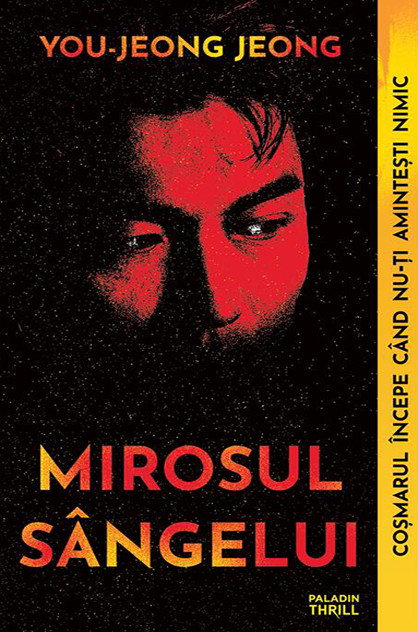
- Rating: ★★★★☆
- Editura: Art, imprint Paladin Thrill
- Traducere: Iolanda Prodan
- Pagini: 360
- Goodreads: Mirosul sângelui
- Poate fi cumpărată de aici: https://www.editura-paladin.ro/info/carte/mirosul-sangelui-you-jeong-jeong
„Mirosul sângelui” de You-jeong Jeong este genul de carte care te prinde încet, dar sigur, și te face să rămâi până la final mai ales din curiozitate. Nu este un thriller alert, plin de acțiune rapidă, ci mai degrabă o poveste care se construiește treptat, cu pași mici, dar apăsători. Pentru mine, a fost o lectură interesantă, chiar dacă ritmul a fost destul de lent și acțiunea mai degrabă liniară. Totuși, tensiunea psihologică compensează acest lucru și te face să vrei să afli adevărul.
Povestea îl urmărește pe Yu-jin, un tânăr care a fost cândva înotător de performanță, dar care acum duce o viață diferită, marcată de tratamente și reguli stricte. Totul începe într-un mod șocant: se trezește într-o dimineață și își dă seama că este acoperit de sânge, fără să aibă vreo amintire clară despre ce s-a întâmplat. Singurele lucruri pe care le știe sunt că a renunțat recent la medicamente și că în noaptea trecută a ieșit să alerge. De aici începe un coșmar real, nu doar prin ceea ce descoperă, ci mai ales prin faptul că mintea lui refuză să-i ofere răspunsuri.
Cartea merge mult pe ideea de memorie și pe cât de fragilă este ea. Yu-jin încearcă disperat să-și reconstruiască ultimele ore, iar cititorul este prins în același joc al incertitudinii. Ce mi s-a părut interesant este felul în care povestea alternează între gândurile lui, amintiri din trecut și fragmente din jurnalul mamei sale. Această combinație adaugă profunzime și ridică și mai multe semne de întrebare despre relația lor, una complicată și plină de tensiuni ascunse.
Pe măsură ce Yu-jin caută adevărul, ies la suprafață secrete de familie care schimbă complet perspectiva asupra lucrurilor. Nimic nu este simplu sau clar, iar imaginea de ansamblu devine din ce în ce mai tulburătoare. Relația dintre el și mama lui este construită într-un mod care te face să te întrebi constant cine spune, de fapt, adevărul și cât de mult poți avea încredere în ceea ce citești.
Mi-a plăcut ideea de bază a romanului: faptul că uneori cel mai mare pericol nu vine din exterior, ci din propriul tău trecut sau din propria minte. Există și o idee care revine subtil: uneori, uitarea pare singura soluție atunci când realitatea devine prea greu de suportat… dar ce se întâmplă când nu poți uita?
În ansamblu, consider că este o carte bună, care merită citită mai ales pentru atmosfera ei și pentru modul în care explorează psihologia personajului principal. Nu este o lectură rapidă sau ușoară, dar este una care te pune pe gânduri și care reușește să mențină suspansul până la final. Eu îi acord patru stele, pentru originalitate și pentru felul în care reușește să te țină prins în mintea unui personaj care nu mai știe nici el ce este real.


The Good Son – You-jeong Jeong
„The Good Son” by You-jeong Jeong is the kind of book that draws you in slowly but surely, making you stay until the very end—mostly out of curiosity. It’s not a fast-paced thriller full of rapid action, but rather a story that builds gradually, with small yet heavy steps. For me, it was an interesting read, even though the pace was quite slow and the plot mostly linear. Still, the psychological tension makes up for that and keeps you wanting to uncover the truth.
The story follows Yu-jin, a young man who was once a competitive swimmer but now lives a very different life, marked by treatments and strict rules. Everything begins in a shocking way: he wakes up one morning and realizes he is covered in blood, with no clear memory of what happened. The only things he knows are that he recently stopped taking his medication and that he went out for a run the night before. From here, a real nightmare begins—not only because of what he discovers, but especially because his mind refuses to give him answers.
The book strongly explores the idea of memory and how fragile it can be. Yu-jin desperately tries to reconstruct his last hours, and the reader is pulled into the same game of uncertainty. What I found particularly interesting is the way the story alternates between his thoughts, memories from the past, and fragments from his mother’s journal. This combination adds depth and raises even more questions about their relationship—one that is complicated and full of hidden tensions.
As Yu-jin searches for the truth, family secrets begin to surface, completely changing the perspective on everything. Nothing is simple or clear, and the bigger picture becomes increasingly disturbing. The relationship between him and his mother is built in a way that constantly makes you question who is actually telling the truth and how much you can trust what you’re reading.
I really liked the core idea of the novel: sometimes the greatest danger doesn’t come from the outside, but from your own past or your own mind. There’s also a subtle recurring idea—sometimes, forgetting seems like the only solution when reality becomes too hard to bear… but what happens when you can’t forget?
Overall, I think it’s a good book, worth reading especially for its atmosphere and the way it explores the psychology of the main character. It’s not a quick or easy read, but it’s one that makes you think and manages to maintain suspense until the very end. I would give it four stars, for its originality and for the way it keeps you trapped inside the mind of a character who no longer knows what is real.
