
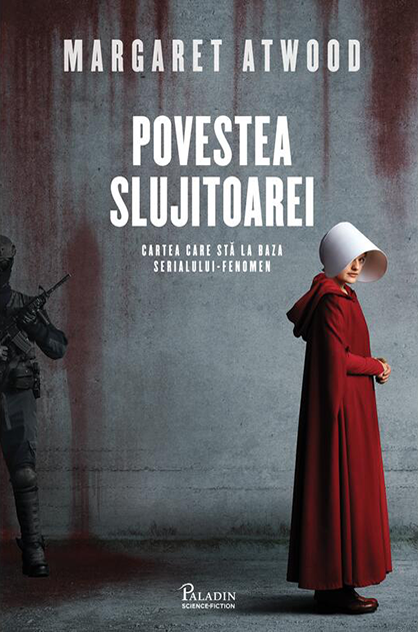
- Rating: ★★★★☆
- Editura: Art, imprint Paladin Science-Fiction
- Traducere: Diana Marin-Caea
- Pagini: 408
- Goodreads: Povestea slujitoarei
- Poate fi cumpărată de aici: https://www.editura-paladin.ro/info/carte/povestea-slujitoarei-editie-tie-in
„Povestea slujitoarei” de Margaret Atwood a fost pentru mine una dintre acele cărți pe care le ții mult timp pe listă, dar parcă le tot amâni în așteptarea momentului potrivit. Mă bucur sincer că, în sfârșit, am ajuns să o citesc, pentru că este o poveste care te lovește direct și nu te lasă indiferent. Chiar și așa, simt că nu am fost pe deplin pregătită pentru ceea ce urma să descopăr între paginile ei.
Romanul ne introduce într-o lume distopică, într-un regim unde viața femeilor este complet controlată. Personajul principal, Offred, este o „slujitoare”, adică o femeie al cărei singur scop este să nască copii pentru familiile conducătoare. Mi-a plăcut felul în care este construită Offred, nu este o eroină clasică, ci mai degrabă o femeie obișnuită, cu frici, amintiri și dorințe, care încearcă să supraviețuiască într-un sistem nedrept. Prin gândurile ei, vedem contrastele dintre trecutul liber și prezentul apăsător.
Pe lângă Offred, apar și alte personaje interesante, fiecare reprezentând o piesă din acest sistem rigid. Serena Joy, soția Comandantului, mi s-a părut un personaj complex. Deși are o poziție superioară, este și ea prinsă într-o viață lipsită de libertate și fericire. Comandantul, în schimb, mi-a dat o senzație ciudată: deși are putere, pare uneori banal și chiar ipocrit. Relațiile dintre personaje sunt tensionate, pline de reguli nespuse și de frică, iar fiecare gest poate avea consecințe grave.
Lectura a fost, sincer, destul de greu de dus pe alocuri. Mi s-a părut crunt să citesc despre felul în care femeile sunt folosite, reduse la simple roluri și lipsite de identitate. Totul este organizat strict: cine are voie să vorbească, cine trebuie să tacă, cine comandă și cine execută. Atmosfera este apăsătoare, iar sentimentul de nesiguranță este constant.
Cu toate acestea, trebuie să recunosc că mi-ar fi plăcut să aflu mai multe detalii despre acest regim. Am simțit că lumea construită de autoare este fascinantă, dar parcă aș fi vrut să fie explorată mai profund: cum sunt împărțiți exact oamenii, cum funcționează toate mecanismele societății, cine și cum ajunge în anumite poziții. Aceste lucruri m-au făcut să rămân cu câteva întrebări chiar și după ce am terminat cartea.
În final, „Povestea slujitoarei” este o lectură puternică, care te pune pe gânduri și te face să apreciezi libertățile pe care le avem. Nu este o carte ușoară și nici una pe care să o uiți repede. Pentru mine a fost o experiență intensă, uneori incomodă, dar cu siguranță memorabilă, motiv pentru care îi ofer patru stele.


The Handmaid’s Tale – Margaret Atwood (The Handmaid’s Tale, #1)
„The Handmaid’s Tale” by Margaret Atwood was, for me, one of those books you keep on your list for a long time, but somehow keep postponing while waiting for the “right moment.” I’m genuinely glad that I finally got around to reading it, because it’s a story that hits you directly and doesn’t leave you indifferent. Even so, I feel like I wasn’t fully prepared for what I was about to discover within its pages.
The novel introduces us to a dystopian world, a regime where women’s lives are completely controlled. The main character, Offred, is a “handmaid,” meaning a woman whose sole purpose is to bear children for the ruling families. I really liked how Offred is portrayed—she’s not a classic heroine, but rather an ordinary woman, with fears, memories, and desires, trying to survive in an unjust system. Through her thoughts, we see the contrast between a free past and an oppressive present.
Alongside Offred, there are other interesting characters, each representing a piece of this rigid system. Serena Joy, the Commander’s wife, seemed like a complex character to me. Although she holds a higher position, she is also trapped in a life lacking freedom and happiness. The Commander, on the other hand, gave me a strange feeling: despite his power, he sometimes seems ordinary and even hypocritical. The relationships between the characters are tense, full of unspoken rules and fear, and every gesture can have serious consequences.
Honestly, the reading was quite difficult to get through at times. It felt brutal to read about the way women are used, reduced to simple roles, and stripped of their identity. Everything is strictly organized: who is allowed to speak, who must remain silent, who commands and who obeys. The atmosphere is heavy, and the sense of uncertainty is constant.
Even so, I have to admit that I would have liked to learn more details about this regime. I felt that the world built by the author is fascinating, but I would have liked it to be explored more deeply: how exactly people are divided, how all the mechanisms of society function, who and how someone ends up in certain positions. These aspects left me with a few questions even after finishing the book.
In the end, „The Handmaid’s Tale” is a powerful read that makes you think and appreciate the freedoms we have. It’s not an easy book, nor one you forget quickly. For me, it was an intense experience, sometimes uncomfortable, but definitely memorable—which is why I give it four stars.
