
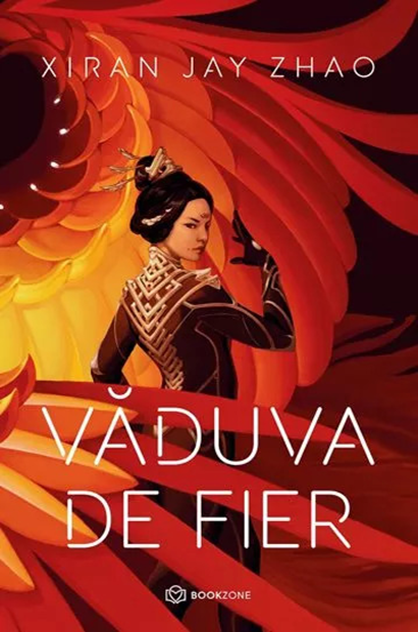
- Rating: ★★★★☆
- Editura: Bookzone
- Traducere: Alina Scurtu
- Pagini: 464
- Goodreads: Văduva de Fier
- Poate fi cumpărată de aici: https://bookzone.ro/carte/vaduva-de-fier-xiran-jay-zhao
„Văduva de Fier” de Xiran Jay Zhao este o carte pe care o aveam pe listă de foarte mult timp. Mereu am fost curioasă de povestea ei, mai ales datorită ideii de fete care pilotează roboți uriași într-o lume inspirată din mitologia și istoria Chinei. Apariția în limba română a celui de-al doilea volum a fost, pentru mine, impulsul perfect ca să încep seria. Și pot spune că primul volum a fost, per total, o experiență destul de interesantă, care m-a surprins în mai multe moduri.
Acțiunea ne poartă într-o lume în care omenirea este atacată constant de creaturi extraterestre, iar singura apărare sunt niște mașinării gigantice, numite crisalide, pilotate de câte un băiat și o fată. Doar că există un dezechilibru crud: de cele mai multe ori, fetele mor în timpul pilotajului, sacrificate pentru a crește puterea băiatului. În acest sistem nedrept o întâlnim pe Wu Zetian, o tânără care se oferă voluntară să devină concubină-pilot, parțial împinsă de la spate de părinții ei care vor primi o sumă de bani în schimbul ei, parțial din dorință de răzbunare. Sora ei a murit într-un astfel de meci, iar Zetian vrea să-l ucidă pe băiatul responsabil.
Zetian este o protagonistă puternică, furioasă, hotărâtă să distrugă un sistem care exploatează femeile. Mi-a plăcut la ea curajul și faptul că nu acceptă regulile impuse de societate. Este directă, uneori brutală, și nu se teme să spună ce gândește. În același timp, trebuie să recunosc că m-a și deranjat pe alocuri. Deși este prezentată ca fiind foarte sigură pe ea, am simțit că în unele momente devine indecisă și își schimbă direcția destul de ușor, în funcție de context sau de influența celorlalți. Parcă se răzgândea de la un capitol la altul, iar asta m-a scos puțin din ritmul poveștii.
Din punct de vedere vizual, cartea mi s-a părut extrem de cinematică. Nu am putut să nu mă gândesc la influențe din „Pacific Rim” sau chiar „Transformers”, mai ales în scenele de luptă cu roboți uriași care se confruntă cu monștri colosali. Luptele sunt intense, dinamice, pline de energie. Autoarea descrie foarte bine conexiunea mentală dintre piloți și modul în care emoțiile lor influențează puterea mașinăriilor. Mi-a plăcut mult felul în care sunt construite aceste confruntări. Sunt spectaculoase, dar au și o încărcătură emoțională puternică.
Un alt aspect care mi-a atras atenția este tema centrală: critica unui sistem patriarhal dur, în care femeile sunt văzute ca simple resurse. Cartea vorbește deschis despre abuz, manipulare, control și despre cât de greu este să lupți împotriva unei tradiții adânc înrădăcinate. Mi s-a părut un subiect actual și bine punctat, chiar dacă uneori mesajul este transmis foarte direct.
În ceea ce privește personajele masculine, Li Shimin și Gao Yizhi sunt foarte diferiți, iar dinamica dintre ei și Zetian aduce multă tensiune în poveste. Totuși, aici ajung la unul dintre lucrurile care m-au deranjat: triunghiul amoros. Mi s-a părut forțat și nenatural pe alocuri, ca și cum ar fi fost introdus special pentru a crea dramă. Aș fi preferat să se pună mai mult accent pe partea de fantasy și science-fiction, pe univers, pe mecanica acelor crisalide, pe misterul din spatele invaziei extraterestre, și mai puțin pe relația în trei, care uneori a eclipsat conflictul principal.
Finalul, însă, a fost partea care m-a surprins cel mai tare. Nu m-am așteptat la acel plot twist și recunosc că tocmai acea răsturnare de situație m-a făcut să ridic punctajul cărții. Mi-a schimbat complet perspectiva asupra întregii povești și m-a făcut să vreau să continui seria cât mai repede.
Per total, „Văduva de Fier” este un început de serie curajos, plin de acțiune, cu idei puternice și scene spectaculoase. Deși am avut câteva nemulțumiri legate de protagonistă și de direcția romantică a poveștii, nu pot nega că m-a captivat și m-a făcut curioasă pentru ce urmează. Pentru mine, este o lectură de patru stele, imperfectă, dar suficient de intensă și surprinzătoare încât să merite descoperită.


Iron Widow – Xiran Jay Zhao (Iron Widow, #1)
“Iron Widow” by Xiran Jay Zhao is a book that had been on my list for a very long time. I was always curious about its story, especially because of the idea of girls piloting giant robots in a world inspired by Chinese mythology and history. The release of the second volume in Romanian was, for me, the perfect push to finally start the series. And I can say that the first book was, overall, quite an interesting experience that surprised me in several ways.
The story takes us into a world where humanity is constantly attacked by alien creatures, and the only defense consists of giant machines called Chrysalises, piloted by one boy and one girl. However, there is a cruel imbalance: most of the time, the girls die during the process, sacrificed to increase the boy’s power. Within this unfair system, we meet Wu Zetian, a young woman who volunteers to become a pilot-concubine, partly pushed by her parents, who will receive money in exchange for her, and partly driven by a desire for revenge. Her sister died in such a battle, and Zetian wants to kill the boy responsible.
Zetian is a strong, angry protagonist, determined to destroy a system that exploits women. I liked her courage and the fact that she refuses to accept the rules imposed by society. She is direct, sometimes brutal, and unafraid to speak her mind. At the same time, I have to admit that she occasionally frustrated me. Although she is portrayed as very self-confident, I felt that in some moments she became indecisive and changed direction rather easily, depending on the context or the influence of others. It felt like she changed her mind from one chapter to the next, and that slightly disrupted the flow of the story for me.
Visually, the book felt extremely cinematic. I couldn’t help but think of influences like „Pacific Rim” or even „Transformers”, especially in the battle scenes featuring giant robots facing colossal monsters. The fights are intense, dynamic, and full of energy. The author does a great job describing the mental connection between the pilots and how their emotions influence the power of the machines. I really enjoyed the way these confrontations are built. They are spectacular, but they also carry strong emotional weight.
Another aspect that caught my attention is the central theme: the critique of a harsh patriarchal system in which women are seen as mere resources. The book openly addresses abuse, manipulation, control, and how difficult it is to fight against deeply rooted traditions. I found the topic relevant and well emphasized, even if the message is sometimes delivered very directly.
As for the male characters, Li Shimin and Gao Yizhi are very different from each other, and their dynamic with Zetian brings a lot of tension to the story. However, this leads me to one of the elements that bothered me: the love triangle. At times, it felt forced and unnatural, as if it had been included specifically to create drama. I would have preferred more focus on the fantasy and science fiction elements—the worldbuilding, the mechanics of the Chrysalises, the mystery behind the alien invasion—and less on the three-way relationship, which sometimes overshadowed the main conflict.
The ending, however, was the part that surprised me the most. I did not expect that plot twist, and I have to admit that this particular turn of events made me raise my rating. It completely changed my perspective on the entire story and made me want to continue the series as soon as possible.
Overall, “Iron Widow” is a bold start to a series, full of action, strong ideas, and spectacular scenes. Although I had a few issues with the protagonist and the romantic direction of the story, I can’t deny that it captivated me and made me curious about what comes next. For me, it’s a solid four-star read—imperfect, but intense and surprising enough to be worth discovering.
