
- Rating: ★★★★☆
- Editura: Niculescu, imprint Fiction / Noir
- Traducere: Maria Tudosescu
- Pagini: 336
- Goodreads: Somn mortal
- Poate fi cumpărată de aici: https://www.niculescu.ro/somn-mortal.html
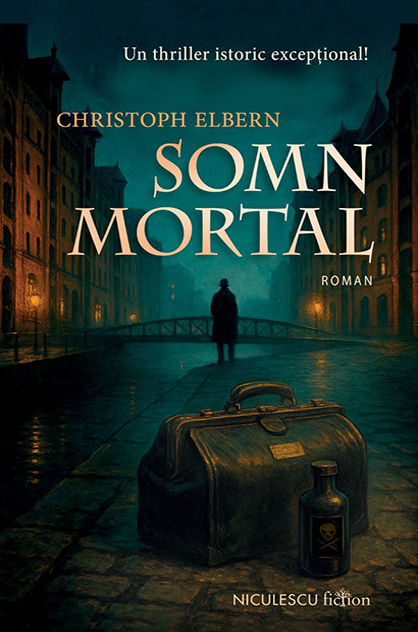
„Somn mortal” de Christoph Elbern este un thriller istoric care m-a prins treptat, dar sigur, și care mi-a rămas în minte mai ales prin temele abordate și atmosfera apăsătoare. Acțiunea are loc în Hamburg, în anul 1907, într-o perioadă în care medicina face pași mari înainte, dar plătește un preț moral uriaș. Autorul reușește să redea foarte bine acest context, iar orașul-port devine un fundal rece și neliniștitor pentru o poveste în care nimic nu este cu adevărat ceea ce pare.
Personajul principal, bacteriologul Carl-Jakob Melcher, lucrează la spitalul portuar și este un om al științei, dar și al conștiinței. Întâlnirea cu Ludolf Harberg, un vechi coleg de școală bolnav de boala somnului, schimbă complet cursul poveștii. Harberg apucă să sugereze că știe lucruri grave despre experimentele făcute de celebrul Robert Koch pe populația locală din Africa de Est Germană, însă moare înainte să spună tot adevărul. Deși medicii pun moartea pe seama bolii, Carl-Jakob simte că ceva nu se leagă și începe să creadă că prietenul său a fost, de fapt, ucis.
Investigația lui Carl-Jakob nu este una clasică, de detectiv, ci mai degrabă o căutare încăpățânată a adevărului. Pe măsură ce sapă mai adânc, descoperă o lume în care știința, puterea și rasismul se amestecă periculos. Discuțiile despre superioritate rasială, despre experimente făcute fără scrupule și despre vieți considerate „mai puțin valoroase” sunt tulburătoare și, din păcate, surprinzător de actuale. Mi s-a părut unul dintre cele mai puternice aspecte ale cărții, pentru că te obligă să privești critic trecutul și să faci legături cu prezentul.
Mi-a plăcut mai mult acest volum decât primul din serie, „Ucigașul din port”. Povestea mi s-a părut mai matură, mai densă și mai curajoasă. Pe alocuri, atmosfera și modul în care sunt construite suspiciunile mi-au dat chiar un ușor vibe de Agatha Christie, mai ales prin felul în care fiecare personaj pare să ascundă ceva. Totuși, nu pot să nu menționez că m-a deranjat puțin faptul că povestea merge în foarte multe direcții. Sunt mai multe fire narative, unele interesante, altele mai greu de urmărit, iar acest lucru a făcut lectura puțin fragmentată pe alocuri.
Per total, „Somn mortal” este un thriller istoric solid, bine documentat, cu personaje credibile și o temă grea, dar importantă. Nu este o lectură ușoară, nici ca subiect, nici ca structură, însă oferă mult în schimb: tensiune, reflecție și o perspectivă incomodă asupra unei epoci nu foarte îndepărtate. Pentru mine, a fost o lectură de patru stele, una care m-a provocat și m-a făcut să mă gândesc mult după ce am întors ultima pagină.


Mortal Sleep – Christoph Elbern (Carl-Jakob Melcher, #2)
“Mortal Sleep” by Christoph Elbern is a historical thriller that drew me in gradually but surely, and that stayed with me mainly because of the themes it explores and its oppressive atmosphere. The action takes place in Hamburg in 1907, at a time when medicine was making great strides forward, but at a huge moral cost. The author succeeds in capturing this context very well, and the port city becomes a cold and unsettling backdrop for a story in which nothing is truly what it seems.
The main character, bacteriologist Carl-Jakob Melcher, works at the port hospital and is a man of science, but also of conscience. His encounter with Ludolf Harberg, an old schoolmate suffering from sleeping sickness, completely changes the course of the story. Harberg manages to hint that he knows serious things about the experiments carried out by the famous Robert Koch on the local population in German East Africa, but he dies before revealing the whole truth. Although the doctors attribute his death to the illness, Carl-Jakob feels that something doesn’t add up and begins to believe that his friend was, in fact, murdered.
Carl-Jakob’s investigation is not a classic detective one, but rather a stubborn search for the truth. As he digs deeper, he uncovers a world in which science, power, and racism mix in dangerous ways. The discussions about racial superiority, unscrupulous experiments, and lives considered “less valuable” are disturbing and, unfortunately, surprisingly relevant. I found this to be one of the strongest aspects of the book, because it forces you to look critically at the past and draw connections to the present.
I liked this volume more than the first in the series, “The Harbor Killer”. The story felt more mature, denser, and bolder. At times, the atmosphere and the way suspicion is built even gave me a slight Agatha Christie vibe, especially through the sense that every character seems to be hiding something. Still, I can’t help but mention that I was a bit bothered by how many directions the story takes. There are several narrative threads—some engaging, others harder to follow—which made the reading experience feel somewhat fragmented in places.
Overall, “Mortal Sleep” is a solid, well-researched historical thriller with believable characters and a heavy but important theme. It is not an easy read, neither in subject matter nor in structure, but it offers a lot in return: tension, reflection, and an uncomfortable perspective on a not-so-distant era. For me, it was a four-star read—one that challenged me and stayed on my mind long after I turned the final page.
